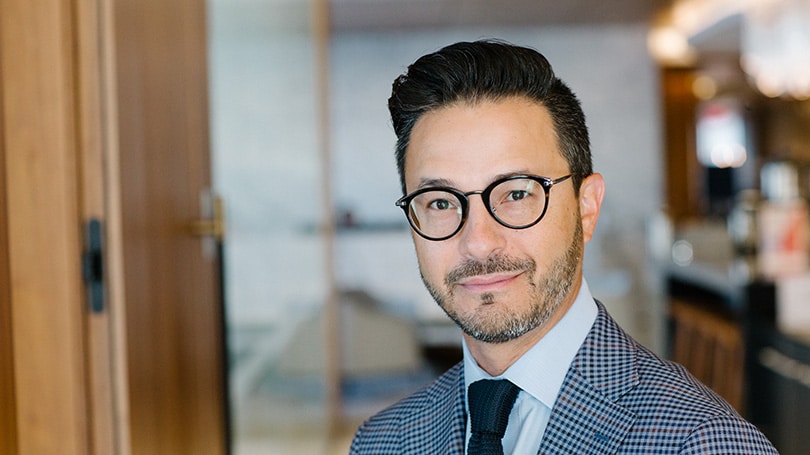
For Peter Cannava, finance is not abstract. At its best, it becomes something you can walk past, live in, rely on, or build a life around. It becomes housing. Schools. Grocery stores. The kind of neighborhoods that have what people need to grow and thrive.
“I get to see capital create housing,” Peter said. “I get to see how capital can change communities and really impact people’s lives.”
That perspective has shaped Peter’s career and his connection to CitizensNYC. Today, he leads Wells Fargo’s community lending and multifamily capital business, where much of the bank’s affordable housing lending, equity investment, and community development finance work is housed. The work that sits at the center of several forces shaping New York every day: finance, housing, public policy, development, and opportunity.
Peter’s path to that work began in New York. Born and raised on Long Island, he moved to the city at 17 to attend NYU and spent more than 20 years living here before he and his wife moved back to Long Island to raise their children. He came of age in Greenwich Village, built his career on Wall Street, and has spent decades watching the city change, recover, rebuild, and reinvent itself.
“I’m definitely a New Yorker through and through,” he said. “I’ve kind of seen all sides of the New York lifestyle.”
After NYU, Peter began his career in an investment banking training program at Bank of America. The hours were long, but they gave him a foundation he still values. He learned the discipline of the work, built relationships, and began to understand what kind of finance mattered most to him.
He knew early on that he wanted his work to connect to tangible things—to see capital move into assets people could use. Over time, that led him to municipal finance and the financing of hospitals, bridges, roads, schools, and housing. Eventually, it led him to Wells Fargo, where he has now spent 17 years.
Affordable housing became especially meaningful to him because it requires people and institutions to work together. A project does not happen because one person has a good idea or one investor writes a check. It takes zoning, local approval, neighborhood support, public subsidy, private dollars, tax credit equity, lenders, developers, and trust.
“What I’ve always loved about the housing business is that it really is a true example of public-private partnership,” Peter said. “We need to find ways to work together to build, because we have a housing crisis. We need more supply.”
That belief also shapes how Peter thinks about the future of New York. The buildings and blocks New Yorkers now fight to preserve were once new, too. The question is not whether the city will change. It is whether that change will make room for more people, more opportunity, and more shared prosperity.
At CitizensNYC, we believe strong neighborhoods are built by the people who live there. Peter sees that same principle from a different vantage point. The scale of his work at Wells Fargo is different, but the underlying idea is familiar: resources matter most when they reach people and places with the vision to use them well.
“It’s got to start somewhere,” he said. “Somebody sees value somewhere, and they’re willing to be the early dollars.”
That early belief can be powerful. In a large development project, a grant or subsidy may look like one small piece of a complicated capital stack. But without that piece, the project may never move. The impact does not stop with one building or one investment.
“It’s amazing how it has that kind of flywheel effect,” Peter said.
That is why Peter sees real alignment between Wells Fargo’s partnership with CitizensNYC and the work happening across neighborhoods every day. Corporate-community partnerships work when they are grounded in shared values, trust, and a belief that both sides are serious about impact. Wells Fargo has supported CitizensNYC for many years, helping direct resources to the local leaders and community projects that strengthen New York from the ground up, including more than $1M in funding support in the last five years alone.
“CitizensNYC is very well respected internally at Wells,” Peter said. “We’re proud to be involved in it.”
Peter remains optimistic about New York because he has seen what the city can survive. He remembers the impact of September 11, the financial crisis, COVID, and the many cycles of challenge and recovery that have shaped the city. He is clear-eyed about what New York needs now: more housing, more development, more investment, and more people willing to work together.
“First and foremost, I’ll never bet against New York,” he told us. We won’t either.
“At the end of the day, what we do have in common is a love for the city,” he said. “We want people to come here for the arts, for the sports, for the shopping, for the business, for the experience of what it’s like to be in such a vibrant place.”
We are proud to honor Peter as one of this year’s New Yorkers for New York: a leader who understands that investment is not only about buildings or balance sheets. It is about people, neighborhoods, opportunity, and the future we are willing to build together.